May 31, 2026
Design of Vibration Test Fixture
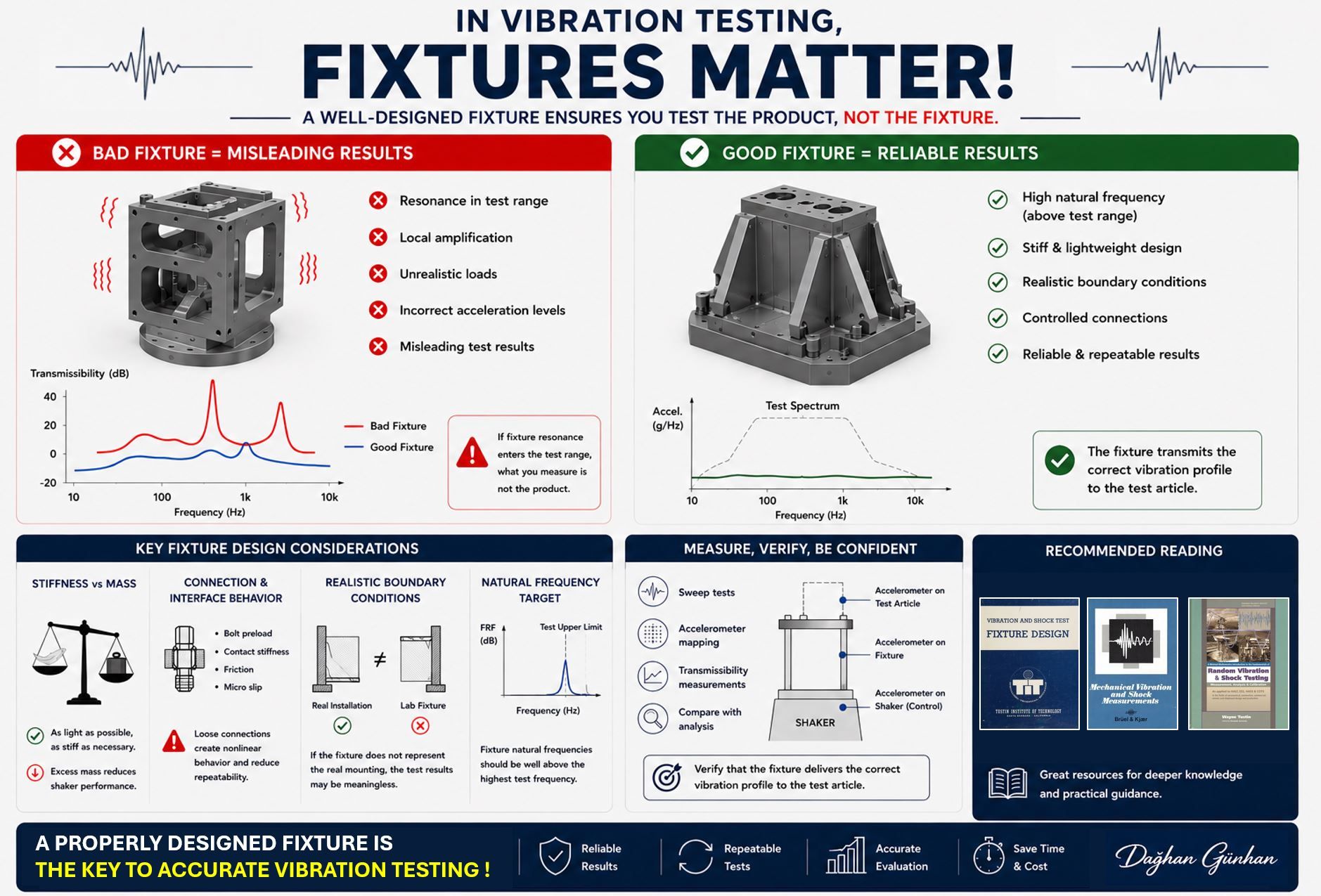
Structural Dynamics Series #4
In vibration testing, you are not only testing the product. You are also testing the fixture. And in many cases, the fixture influences the test results just as much as the product itself.
A vibration fixture is not simply "a structure that holds the part." It is the dynamic interface between the shaker and the test article. That means the fixture's stiffness, mass, natural frequencies, damping characteristics, and connection details directly affect the test behavior.
The most critical problem
Fixture resonances entering the test frequency range. Because once resonance occurs, the vibration you input is no longer the vibration the product actually experiences. The result: local amplification, unrealistic loads, incorrect acceleration levels, and misleading test results.
For this reason, during fixture design, fixture natural frequencies and the test vibration profile must be evaluated together. Before starting the actual test, a preliminary test should be performed, results should be compared with analysis predictions, and the fixture's dynamic behavior must be validated.
The location of shaker control accelerometers is also critically important. Transmissibility should be calculated using accelerometers placed on the fixture base, the fixture top, and the test article, then compared with analytical results. This ensures that the fixture transfers the correct vibration profile to the system. That's why sweep tests, accelerometer mapping, and transmissibility measurements are critical.
Stiff isn't always best
A very stiff fixture is not always the best fixture. Because increasing stiffness usually means increasing mass, and increased mass can reduce shaker performance, limit maximum achievable acceleration, and change the system dynamics. That's why a fixture should be as light as possible, but as stiff as necessary.
Bolt connections matter
In real systems, bolt preload, contact stiffness, friction, and micro-slip can significantly alter the dynamic response. Especially loose connections can introduce nonlinear behavior, which can reduce test repeatability.
A fixture design that does not represent real boundary conditions can make the entire test meaningless. If the product is mounted differently in the real vehicle, aircraft, or operating system, laboratory results may fail to represent real-life behavior.
Conclusion
A poorly designed fixture can invalidate even a perfectly executed vibration test. A good vibration fixture should be sufficiently stiff, lightweight, resonance-controlled, representative of real boundary conditions, and measurable and verifiable.
Originally posted on LinkedIn.