April 12, 2026
Modal Analysis & Testing: Understand Your System, Understand Its Frequency
Structural Dynamics Series #1
"If you want to find the secrets of the Universe, think in terms of energy, frequency and vibration." — Nikola Tesla
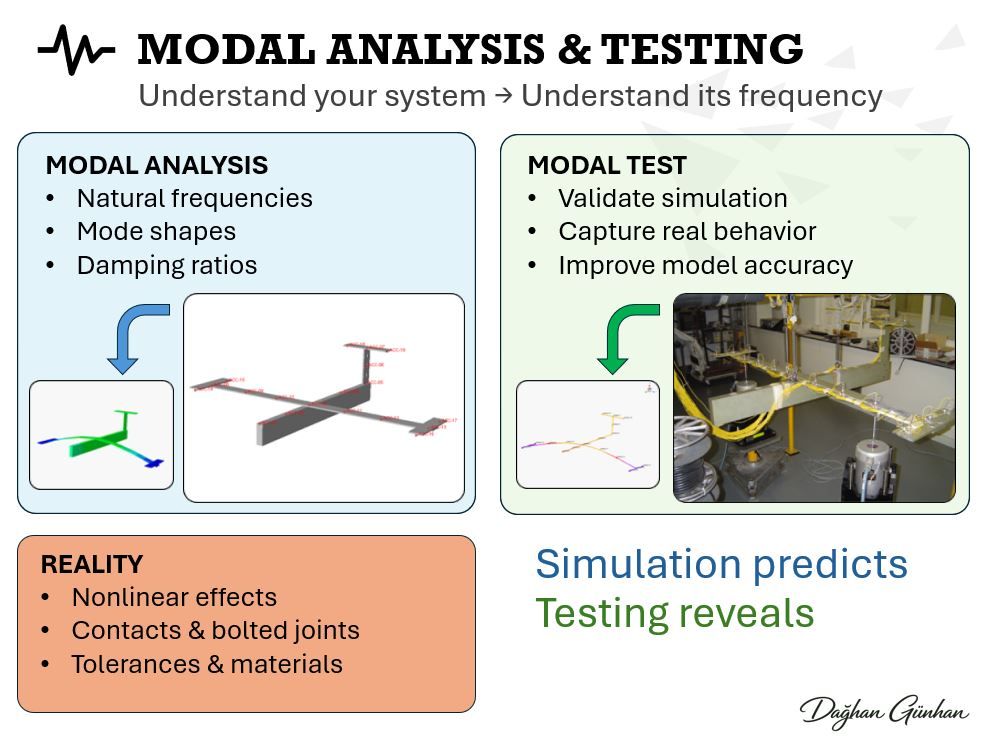
Modal analysis and testing are among the most powerful tools to understand the dynamic behavior of a system. They allow us to identify:
- Natural frequencies
- Mode shapes
- Damping ratios
These are not just results — they are the characteristic properties of the system.
A simple example
When you pluck a guitar string, you always hear the same note. Because its material, diameter and tension define that frequency. Engineering systems behave in the same way.
- Natural frequency → where the system wants to vibrate
- Mode shape → how it vibrates
- Damping → how quickly it stops
These give us critical insights: where is the system weak? Where is it over-designed? How will it behave under vibration?
The reality behind the assumption
Modal analysis assumes linear behavior. Real systems are never perfectly linear — contacts, bolted joints, tolerances, and rubber isolators all introduce nonlinear effects.
That's why we perform modal testing and validate our models. This process isn't just about finding frequencies — it's about validating the model, verifying mass and inertia properties, and capturing real system behavior.
The result: modal analysis and testing help us identify problems early, before they turn into costly issues later in the design process. Especially critical for vibration-sensitive systems and NVH (noise, vibration, harshness) driven designs.
References
Originally posted on LinkedIn.