July 12, 2026
The Biggest Misconception About MIL-STD-810 Vibration Profiles
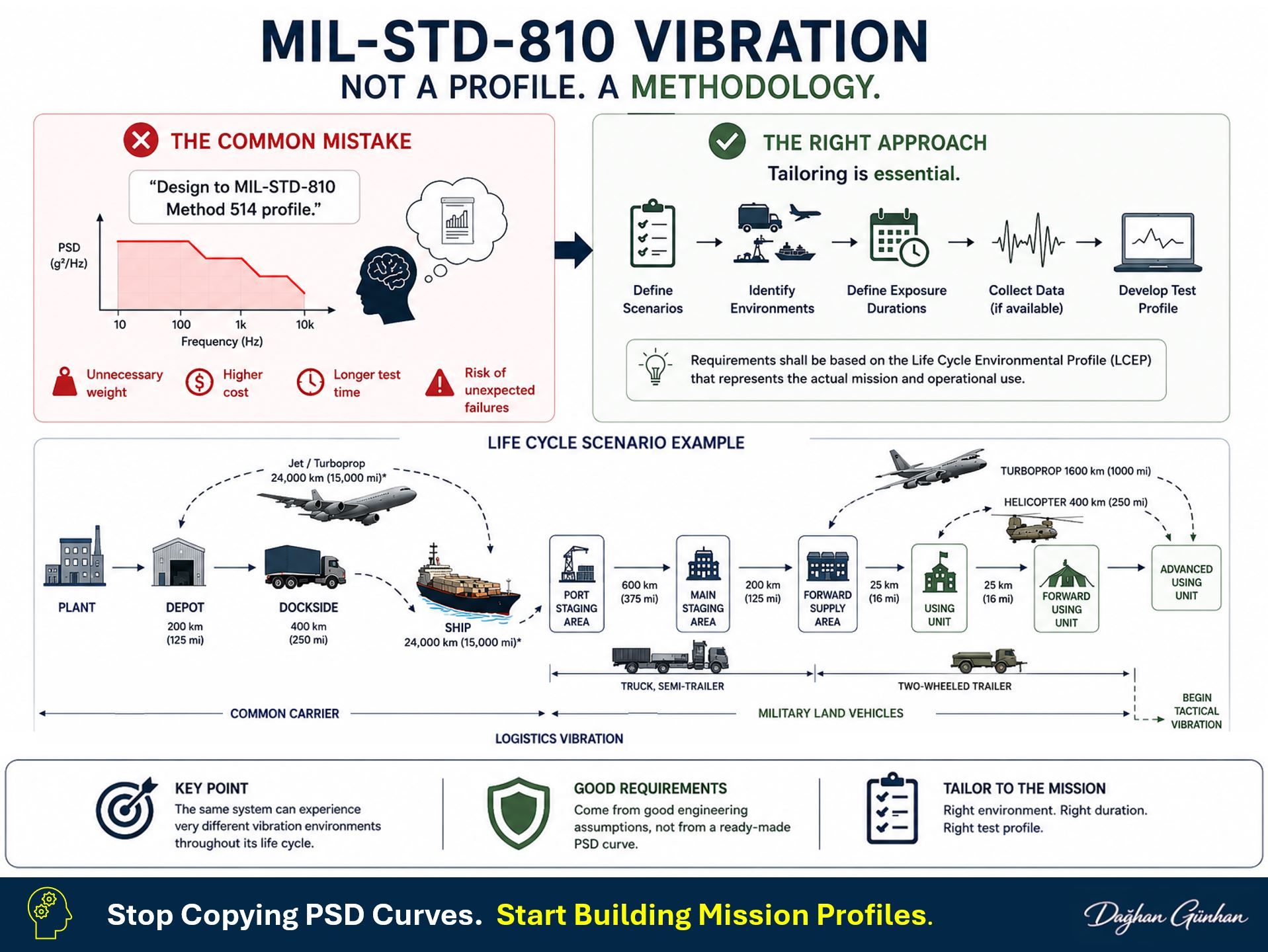
Structural Dynamics Series #6
Don't let your life cycle become your cost cycle.
If you work in aerospace, defense, or any industry that develops products for harsh environments, you've probably heard of MIL-STD-810 — one of the world's most widely used environmental engineering standards. It provides methods for evaluating how equipment performs under conditions such as vibration, shock, temperature, humidity, sand, dust, rain, and many other environmental loads. One of its most frequently used sections is Method 514 – Vibration.
However, one of the biggest misconceptions is believing that MIL-STD-810 provides a single vibration profile that every product should satisfy. It doesn't.
Where the mistake begins
When defining system or subsystem requirements for a new product, or preparing technical specifications for suppliers, you eventually need to specify environmental vibration requirements. What usually happens is something like: "the system shall be designed to withstand the ... vibration profile defined in MIL-STD-810 Method 514.8." This is where the first major mistake begins.
MIL-STD-810 does not provide a single vibration profile — instead, it provides an engineering methodology for developing one. One of the most important messages in the standard is that tailoring is essential. The same vibration profile should not be applied to every system.
The first question
What does the system's life cycle look like? Will the system be transported by truck, mounted on an off-road vehicle, installed on a helicopter, operated on an aircraft, or used aboard a ship? Or will it experience several of these environments throughout its life? Each represents a completely different vibration environment.
Vibration level alone does not determine fatigue damage — exposure duration is just as important.
The right approach
Work with the customer to define the actual life cycle of the product:
- Identify transportation scenarios
- Define operational environments
- Determine exposure durations
- Collect field measurement data whenever possible
- Then develop the laboratory vibration test profile
MIL-STD-810 Annex F explains in detail how laboratory vibration profiles can be derived from measured field data.
What happens if this process is skipped?
The system may be designed for unnecessarily severe vibration environments — unnecessary weight, increased cost, longer qualification testing. Or even worse, the system may be qualified using vibration levels that do not represent its real operating environment, leading to unexpected failures in service.
Originally posted on LinkedIn.