April 26, 2026
The Test May Be Correct — But the Result Can Be Wrong
Structural Dynamics Series #2
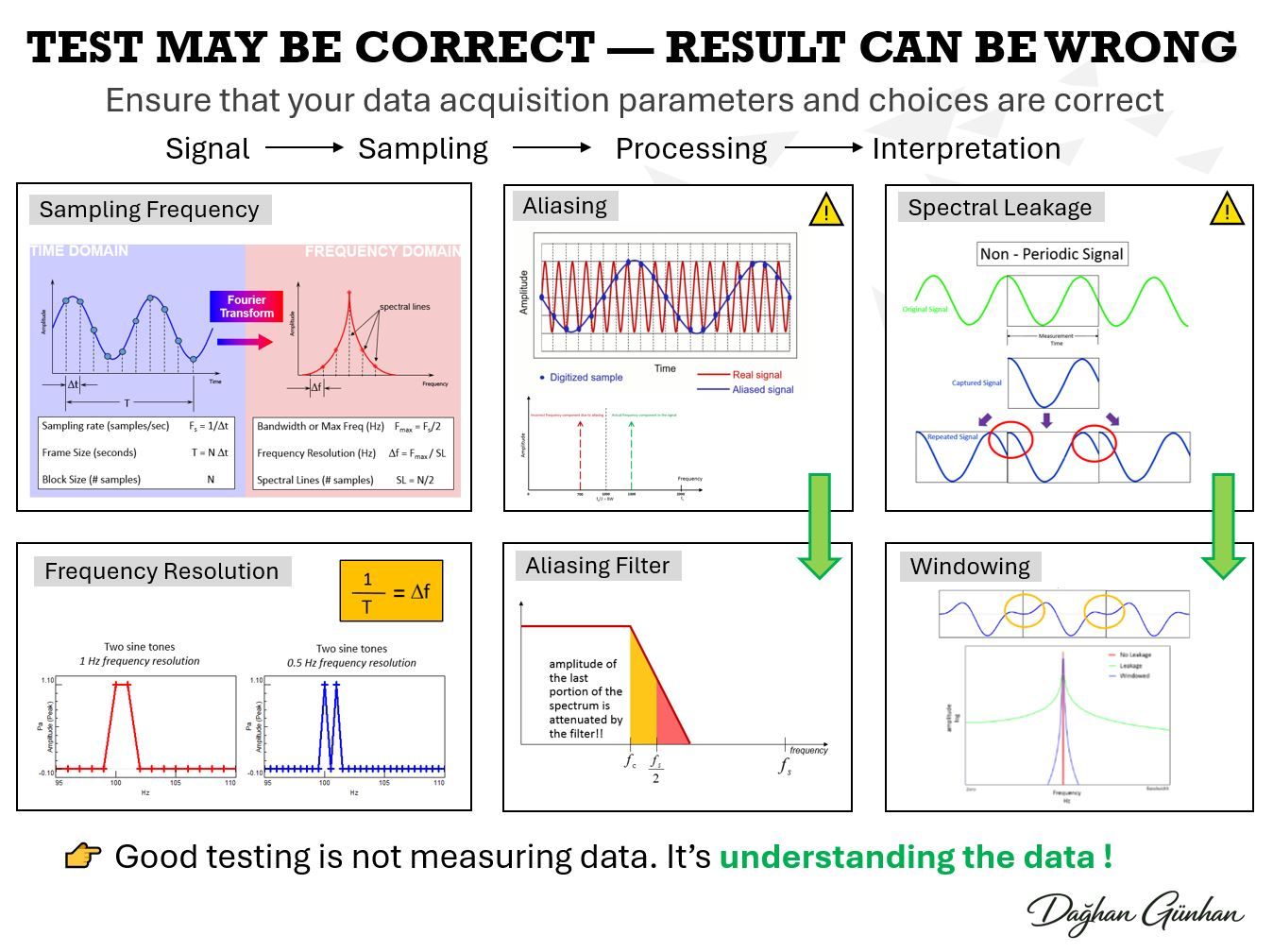
One of the critical aspects in vibration testing is ensuring that your data acquisition parameters and choices are correct. The signal we measure is continuous (analog), but we record it as discrete (digital) — and the choices we make here directly affect the results.
1. Sampling frequency
Sampling frequency defines how many data points we collect per second.
Nyquist Criterion — you must sample at least 2 times the maximum frequency you want to measure. Otherwise, aliasing occurs: high-frequency components appear as lower frequencies due to insufficient sampling. In other words, if your sampling frequency is not sufficient, you may observe frequencies that do not exist in the system, or misinterpret the ones that actually exist.
2. Frame size (sampling duration)
The ability to distinguish frequencies in the frequency domain is called frequency resolution, and it depends on measurement duration — the longer the "meaningful" measurement duration, the higher the resolution.
3. Windowing
In real life, signals are not perfectly periodic, and when we capture them within a time window, they do not start and end at zero. When these windows are repeated, the discontinuities created lead to spectral leakage — energy does not appear at a single frequency, it spreads over a wider frequency band.
To reduce this effect, we use windowing. But windowing does not eliminate the error — it only reduces and controls it.
Conclusion
In vibration testing, the right sensor, the right test setup, and the right data acquisition system are important — but there is one more critical aspect: collecting and processing the data correctly.
Good test engineering is not just about measuring data. It's about truly understanding what you measure.
References
Originally posted on LinkedIn.