July 19, 2026
Why Does Element Selection Matter in Finite Element Analysis?
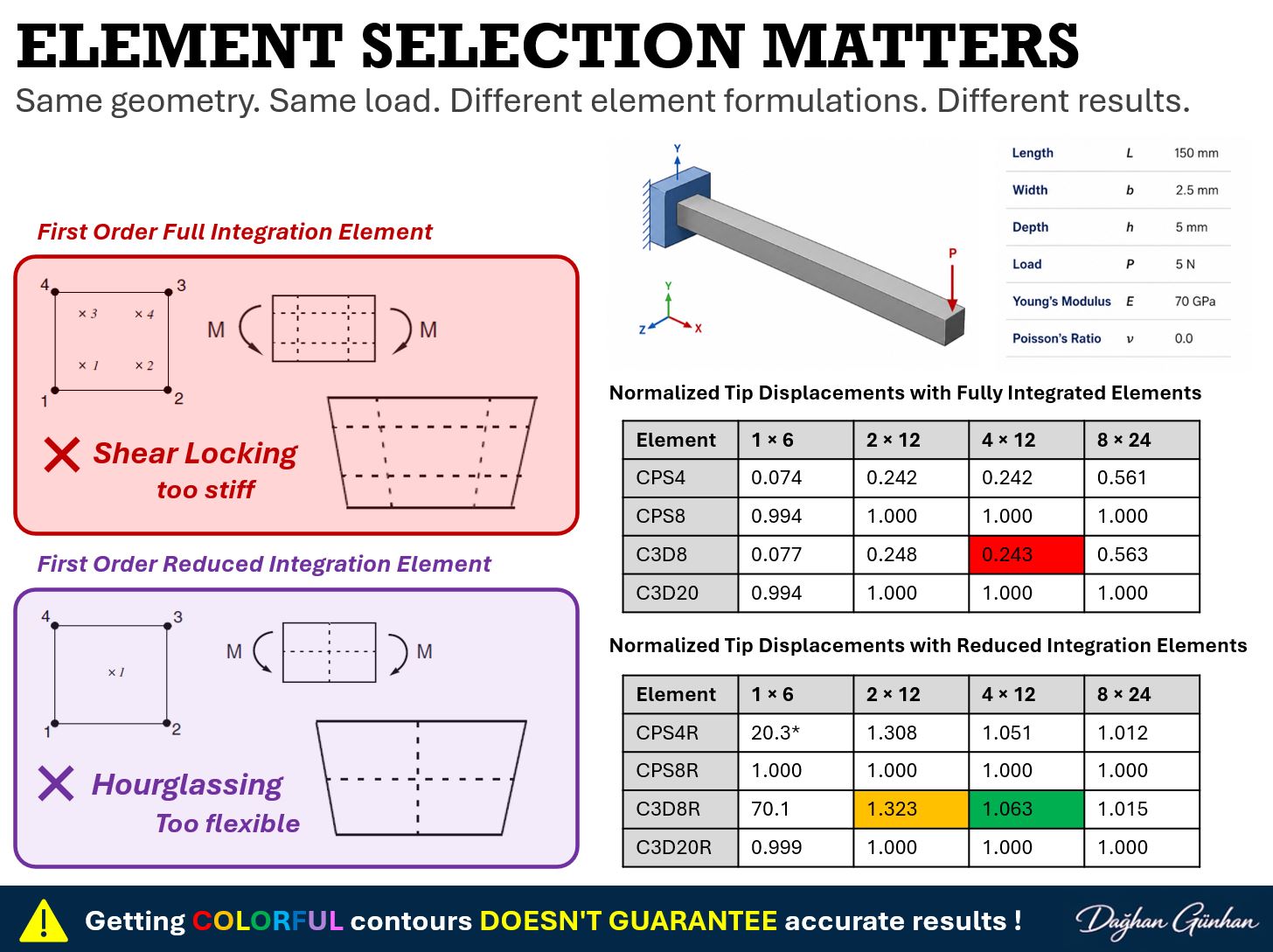
Structural Analysis Learning Series #3
One of the most common assumptions among engineers who are new to finite element analysis is: "I created the model, generated the mesh, ran the analysis... so the results must be correct."
Unfortunately, it is not that simple. The accuracy of an FEA model is not determined by mesh density alone — the element formulation you choose can have a significant impact on your results.
The classic cantilever beam example
Two well-known numerical issues become apparent in this example.
1. Shear locking
Fully integrated first-order solid elements (such as C3D8) tend to become artificially stiff in pure bending. The reason is that these elements cannot accurately reproduce the curvature associated with bending. As a result, the element develops spurious transverse shear strains that should not exist in a pure bending state.
2. Hourglassing
To avoid shear locking, reduced integration elements were introduced. By using fewer Gauss integration points, these elements largely eliminate shear locking. However, this introduces another numerical issue: certain deformation modes generate little or no strain energy, allowing the element to deform in nonphysical ways. This phenomenon is known as hourglassing.
To control these zero-energy modes, Abaqus introduces hourglass stabilization. The documentation also recommends using at least four elements through the thickness when linear reduced integration elements are used in bending-dominated problems.
The benchmark
I recreated the exact cantilever beam example. In addition to the solid element, I also included two beam formulations: C3D8R, B33, and B31.
The C3D8R solid element showed approximately 6.3% error, which is consistent with the Abaqus documentation. However, if the same problem had been solved using a fully integrated C3D8 element, the error would have increased to approximately 75%. Likewise, if I had used C3D8R but reduced the mesh to only two elements through the thickness instead of four, the error would have increased to approximately 32%.
This clearly shows that both the element formulation and the mesh topology can dramatically influence the accuracy of an analysis.
Obtaining colorful contour plots does not necessarily mean the solution is correct.
The full benchmark write-up, including the beam element comparison, is available as a PDF: Element Selection — Cantilever Beam Benchmark.
Originally posted on LinkedIn.