June 21, 2026
Where Should I Begin With Structural Analysis?
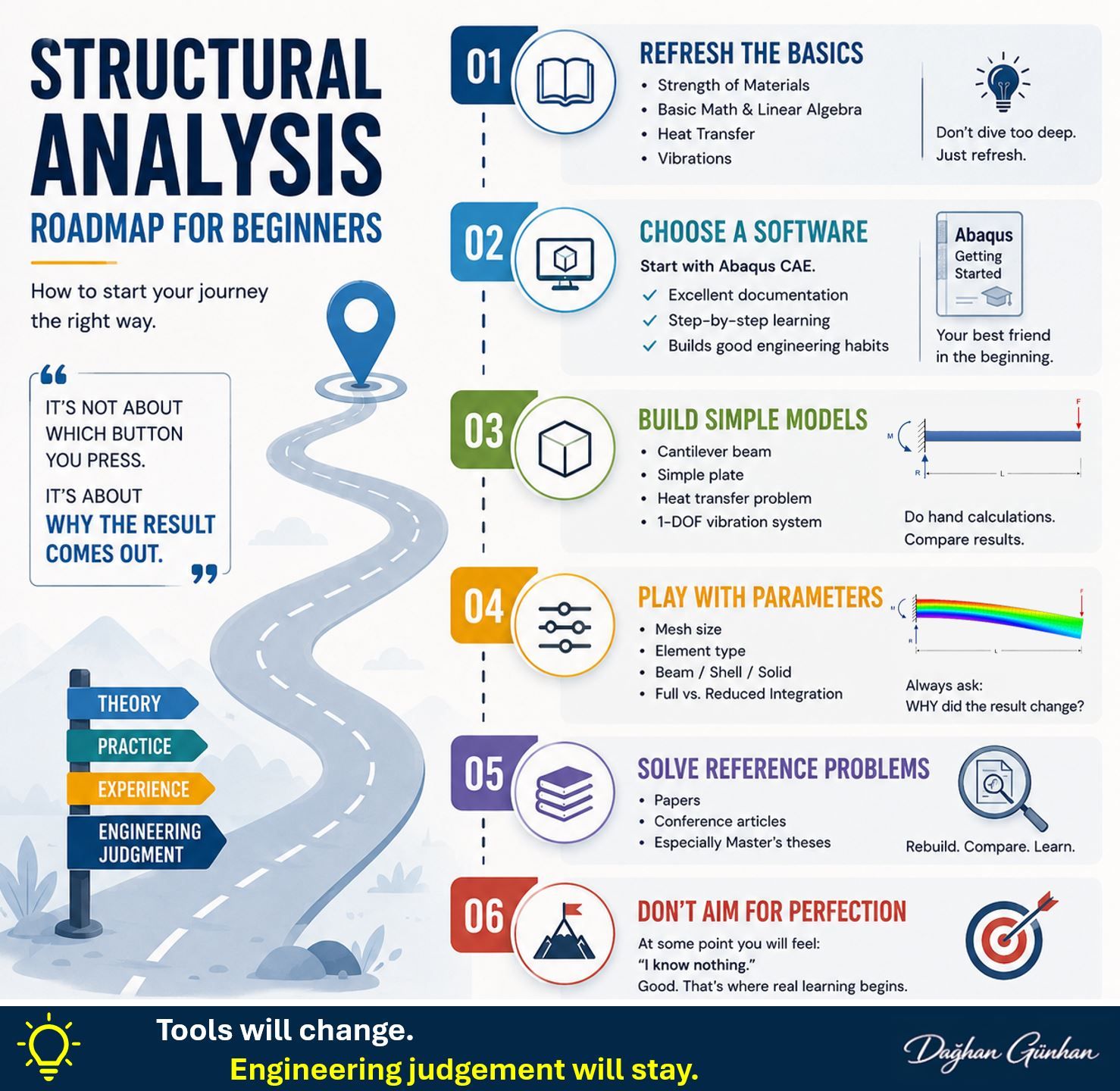
Structural Analysis Learning Series #1
"I want to get started with structural analysis. Where should I begin?" This is a question I get quite often. Usually, it comes in one of two forms: "should I learn the theory first?" or "should I learn an analysis software first?"
Having gone through both a theory-heavy FEM education and software-focused training over the years, my answer is: learn both at the same time. Without theory, analysis becomes little more than pushing buttons. Without software, theory often remains abstract. Just like in engineering itself, theory and practice should grow together.
If I were starting from scratch today, here's how I'd approach it.
1. Refresh the fundamentals
Start by revisiting Strength of Materials, basic matrix operations, heat transfer fundamentals, and mechanical vibrations fundamentals. But don't spend months buried in theory — the goal is to refresh, not to master everything immediately.
2. Choose a software package
Abaqus, Ansys, Nastran, LS-DYNA... people often ask which software is the best. The reality is that understanding analysis is far more important than understanding a specific software. For beginners, I usually recommend Abaqus CAE with the Abaqus Getting Started Guide — excellent documentation, a step-by-step learning path, and it helps build good engineering habits.
3. Build small models
The first goal is not solving complex systems — it's solving simple problems. For example: a cantilever beam, a simple plate, a heat transfer problem, a single degree-of-freedom vibration system, or the natural frequency of a free beam. Do a hand calculation first, then run the simulation, then compare the results.
4. Play with parameters
This is where real learning begins. Change mesh size, element type, beam/shell/solid modeling approaches, full vs. reduced integration — and always ask why the result changed.
5. Recreate reference studies
Eventually, your own examples will not be enough. At this stage, journal papers, conference papers, and especially master's theses become incredibly valuable. Trying to reproduce published work teaches far more than simply reading it.
6. Don't aim for perfection
At some point you will think "I actually know nothing." That's normal. In fact, for many engineers, that is exactly where real learning begins.
Final advice
When learning finite element analysis, don't focus only on which button to click — focus on understanding why the result looks the way it does. Because throughout your career, the software you use will change. But your engineering judgment will stay with you.
Originally posted on LinkedIn.