August 2, 2026
The Cost of Finding It Late
Beyond the Model Series #8
A few years ago I was working on a heavy-duty lifting system. A large platform, high static and dynamic loads, a long expected service life.
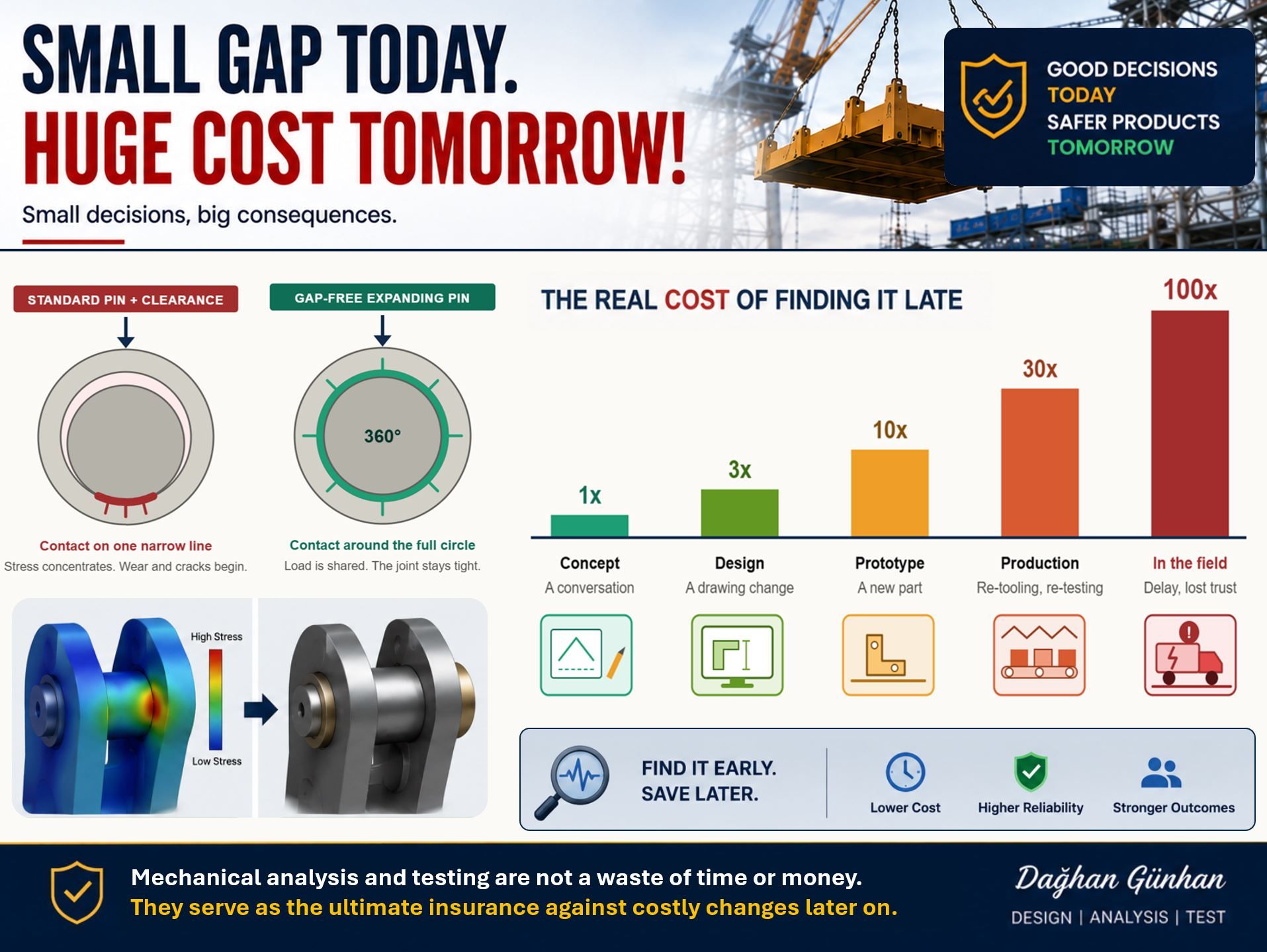
During the design reviews, we took a closer look at one joint. There was a small clearance between two connected parts. On paper it looked harmless. In reality, that clearance meant the load was not being transferred evenly.
When we ran the analyses, we saw that the load was concentrating on a far smaller area than assumed. Under repeated loading, that is exactly where cracks begin.
After reviewing the optimisation work and the solutions currently used for this problem, we moved to a gap-free joint concept. The approach had been proven for years in heavy machinery; we adapted it to this platform. Discussions were held with the supplier, and the design changed before it went into production.
A few weeks of engineering work prevented a problem that could have caused major costs in the later stages of the project.
What if it had been missed?
If that joint had gone into production with the clearance, the failure would not have shown up immediately. It would most likely have passed the prototype tests. Perhaps months later, in the field, under repeated loading, a crack would have appeared.
At that point the cost is no longer a design change. It is:
- Redesign of an already approved structure
- New manufacturing and tooling cost
- Re-testing and re-qualification
- Delayed delivery to the customer
- A loss of reputation that is hard to repair
Same problem. A completely different bill.
A pattern across industries
This is the pattern I keep seeing across defence, automotive and industrial projects: the problem itself is almost never expensive. Finding it late is.
A design review costs a few engineering hours, while a failure in the field can cost the project.
And here's the hardest part about these reviews: when they work, there is nothing left to show. There is no crack, no delay, no crisis. There is only a product that works properly. A prevented problem being invisible does not make it unimportant.
Most companies do not skip analysis because they think it is unnecessary. They skip it because it feels like a delay at the start of a project. It is not a delay. It is the most cost-effective insurance you can buy for that product.
If you are developing a product that carries load, vibrates, or has to survive years in the field, and you are not sure whether your design holds a hidden weak point, that is exactly the kind of question worth asking early.
Originally posted on LinkedIn.