July 5, 2026
Which Books Should I Read to Learn Structural Analysis?
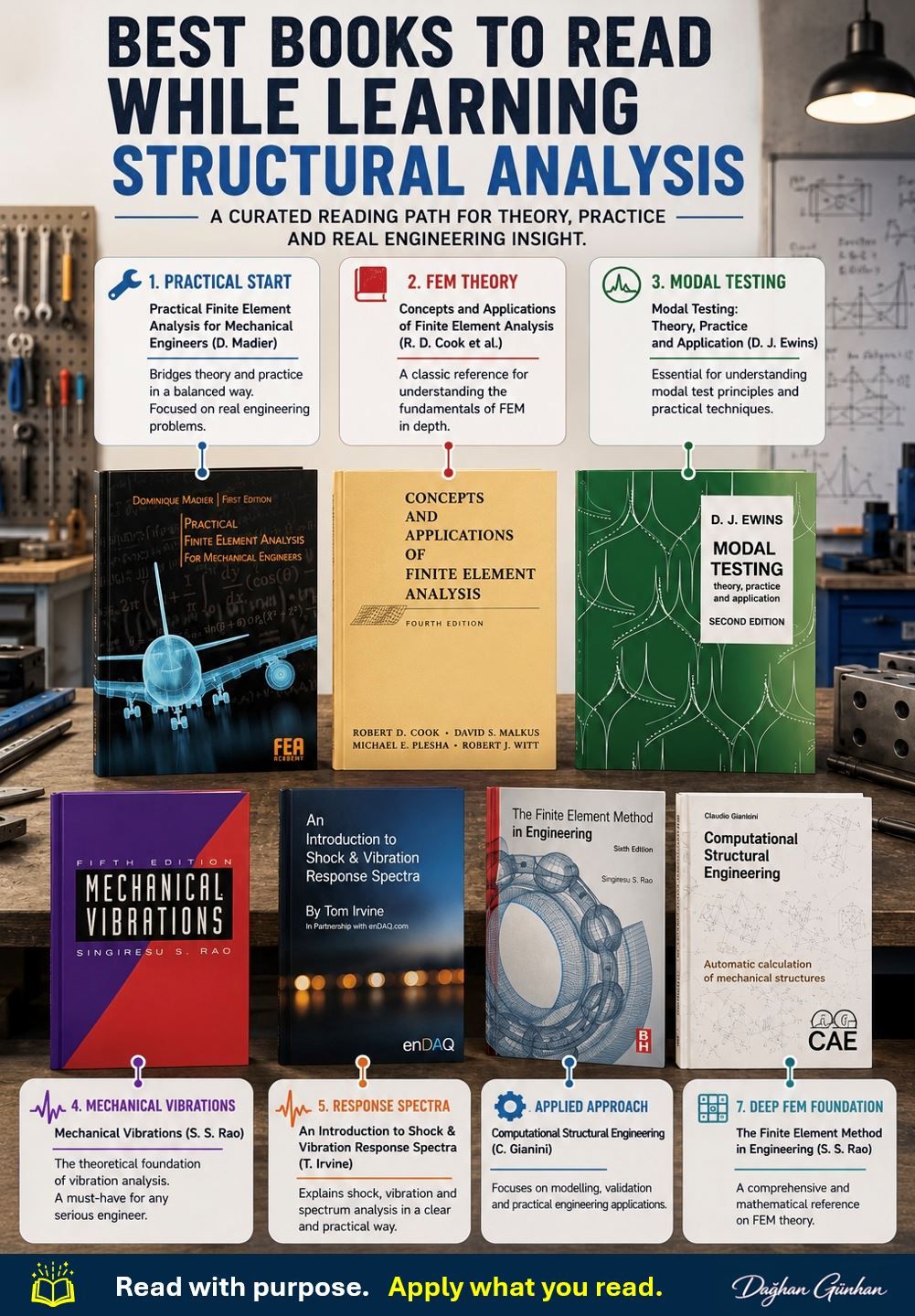
Structural Analysis Learning Series #2
"I want to learn structural analysis. Which books should I read? What resources should I use?"
Before recommending any books, I'd like to mention a common mistake many engineers make at the beginning of their careers: they constantly look for new resources, buy new books, enroll in new courses — but rarely spend enough time solving the same problem using different approaches.
The truth is, in structural analysis, progress comes from solving more problems, not from consuming more resources. That said, some references are truly worth your time.
1. A practical starting point
Practical Finite Element Analysis for Mechanical Engineering — Dominique Madier
Theory and practice should develop together throughout the learning process. Diving too deeply into theory from the very beginning can easily become overwhelming. This is one of the best books I've found for beginners — it strikes an excellent balance between theory and practical application, explaining concepts through real engineering problems rather than purely academic examples.
2. Applied structural analysis
Computational Structural Engineering — Claudio Gianini
One of my personal favorites. Particularly strong in modeling strategies and common modeling mistakes, interpreting simulation results, and applications based on real engineering systems. More importantly, it teaches you how to think like a structural analysis engineer.
3. For those who want to understand FEM theory
- Concepts and Applications of Finite Element Analysis — Robert Cook
- The Finite Element Method in Engineering — Singiresu Rao
These books are invaluable if you want to understand what is actually happening behind commercial FEA software. I also recommend implementing simple finite element models yourself in MATLAB or Python while studying these books — one of the best ways to understand the underlying theory.
4. Structural dynamics and vibration
- Mechanical Vibrations — Singiresu Rao
- Modal Testing — D.J. Ewins
- An Introduction to Shock & Vibration Response Spectra — Tom Irvine
- Modal Space articles — Peter Avitabile
Excellent resources, especially if you're interested in understanding the relationship between simulation and experimental testing.
My most important advice
Don't try to finish a book. Read one chapter. Then build the model. Then question the results.
Structural analysis is not learned by simply reading. It is learned by studying, calculating, building models, interpreting results, and making mistakes. That's where real engineering intuition begins.
Originally posted on LinkedIn.