May 24, 2026
Two Parts Can Be Within Tolerance and Still Fail to Assemble
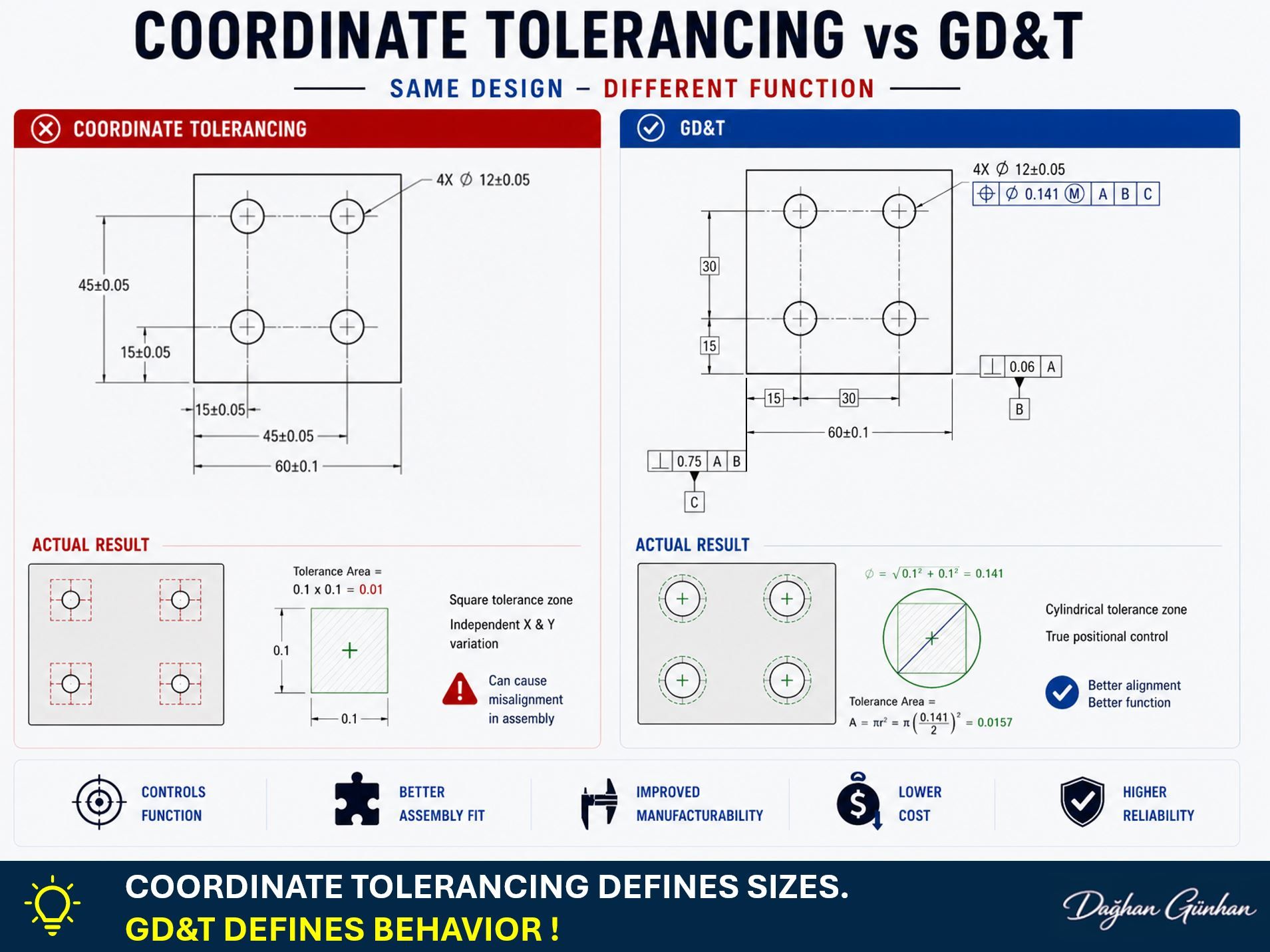
Beyond the Model Series #5
Two parts can be within tolerance and still fail to assemble properly. One of the biggest limitations of traditional tolerancing is this: it controls dimensions, but not always function.
Traditional coordinate tolerancing
In conventional tolerancing, features are controlled independently in the X and Y directions, and tolerance zones are rectangular/square. At first glance this may seem sufficient. But in reality, positional error grows diagonally.
So what changes with GD&T?
GD&T (Geometric Dimensioning & Tolerancing) defines functional geometric behavior, not just dimensions. Instead of rectangular tolerance zones, it uses circular or cylindrical tolerance zones — providing better control of positional accuracy, better alignment between mating parts, and better representation of real assembly conditions.
A concrete example
Consider the tolerance of four bolt holes connecting to the same mating surface, defined once using traditional coordinate tolerancing and once using GD&T.
With coordinate tolerancing at ±0.05 mm in X and ±0.05 mm in Y, this can still create ~0.14 mm diagonal positional deviation — and that difference can become critical in assemblies.
Now the opposite case: assume your system can actually tolerate a Φ0.14 mm positional deviation. But if you define this using coordinate tolerancing as ±0.05 mm, you unintentionally specify a much tighter tolerance. Comparing the tolerance zone areas, coordinate tolerancing creates nearly 50% smaller allowable area — resulting in more difficult manufacturing, higher production cost, and more rejected parts during quality inspection.
The most important concept: datums
A datum system is not just a reference — it represents how the part is actually positioned and functions in the real assembly. That's why GD&T becomes extremely powerful for precision assemblies, complex mechanisms, aerospace systems, and high-performance products. It also provides significant guidance for both manufacturing operators and quality control engineers.
GD&T can simultaneously tighten critical functional regions and relax non-critical regions, resulting in better manufacturability, lower production cost, and more consistent functional behavior.
Conclusion
Traditional tolerancing defines size. GD&T defines behavior. And in engineering, functional behavior is what truly matters.
Reference
Originally posted on LinkedIn.