May 17, 2026
Extreme Environments: Cryogenic and Vacuum Systems
Beyond the Model Series #4
Engineering completely changes when systems operate under extreme conditions. High temperature, low temperature, vacuum, pressure, vibration, shock — all of them can drastically affect system behavior. In this post, let's briefly focus on cryogenic and vacuum systems.
Cryogenic systems
Cryogenic systems operate at extremely low temperatures (typically below -150°C). Common application areas include space and rocket systems, fusion technologies, MRI systems, and superconducting applications.
As temperature decreases, materials behave differently: steels may become brittle, plastics may crack, elastomers may harden. A design that works perfectly at room temperature may fail completely in a cryogenic environment.
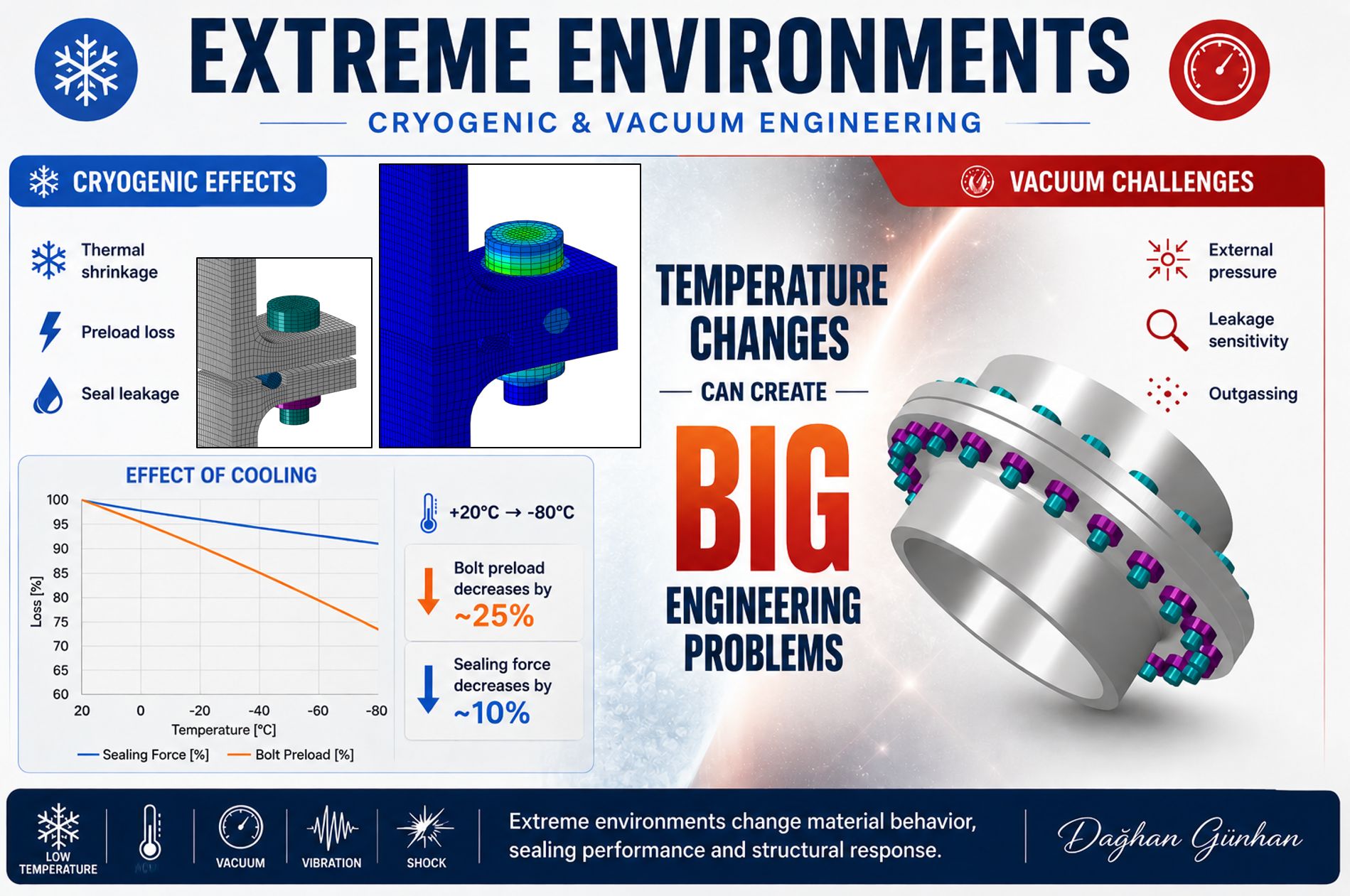
Thermal shrinkage — everything shrinks when cooled. A 1-meter steel component can contract by several millimeters. These small dimensional changes can lead to bolt preload loss, tolerance shifts, and seal leakage.
In one example analysis: a high-performance thermoplastic flange connection with steel bolts and an elastomer seal was evaluated. With a temperature drop from +20°C to -80°C, bolt preload decreased by ~25% and sealing force decreased by ~10%. These reductions directly affect the maximum internal pressure the flange can withstand.
Heat leakage — one of the biggest challenges in cryogenic systems is heat entering the system from the environment, causing cryogenic liquids to vaporize. Vacuum insulation and multi-layer insulation (MLI) are commonly used to address this.
Vacuum systems
Vacuum engineering also changes the rules completely. Under vacuum conditions, external pressure pushes the system inward — structures may collapse due to implosion risk.
Even very small leaks can destroy vacuum performance, which is why systems rely on CF flanges, copper gaskets, and helium leak testing.
Outgassing — some materials release gases under vacuum conditions, significantly degrading vacuum quality. As a result, material selection becomes extremely critical.
Conclusion
Cryogenic and vacuum engineering are not just about "low temperature" or "low pressure." They require combined understanding of material behavior, heat transfer, structural mechanics, sealing performance, and manufacturing quality. In extreme environments, small details can become very big problems.
Originally posted on LinkedIn.