July 26, 2026
What If the Best Design Decision Is Deleting a Part?
Beyond the Model Series #7
Some engineers design great parts. Others design great products. Those are not the same thing.
A part can be incredibly strong. The simulation results can look perfect. But if the product is still expensive to build, difficult to assemble, and unnecessarily complex, can we really call it a good product? Good engineering is not only about optimizing individual parts — it's also about simplifying the product as a whole.
The DFMA philosophy
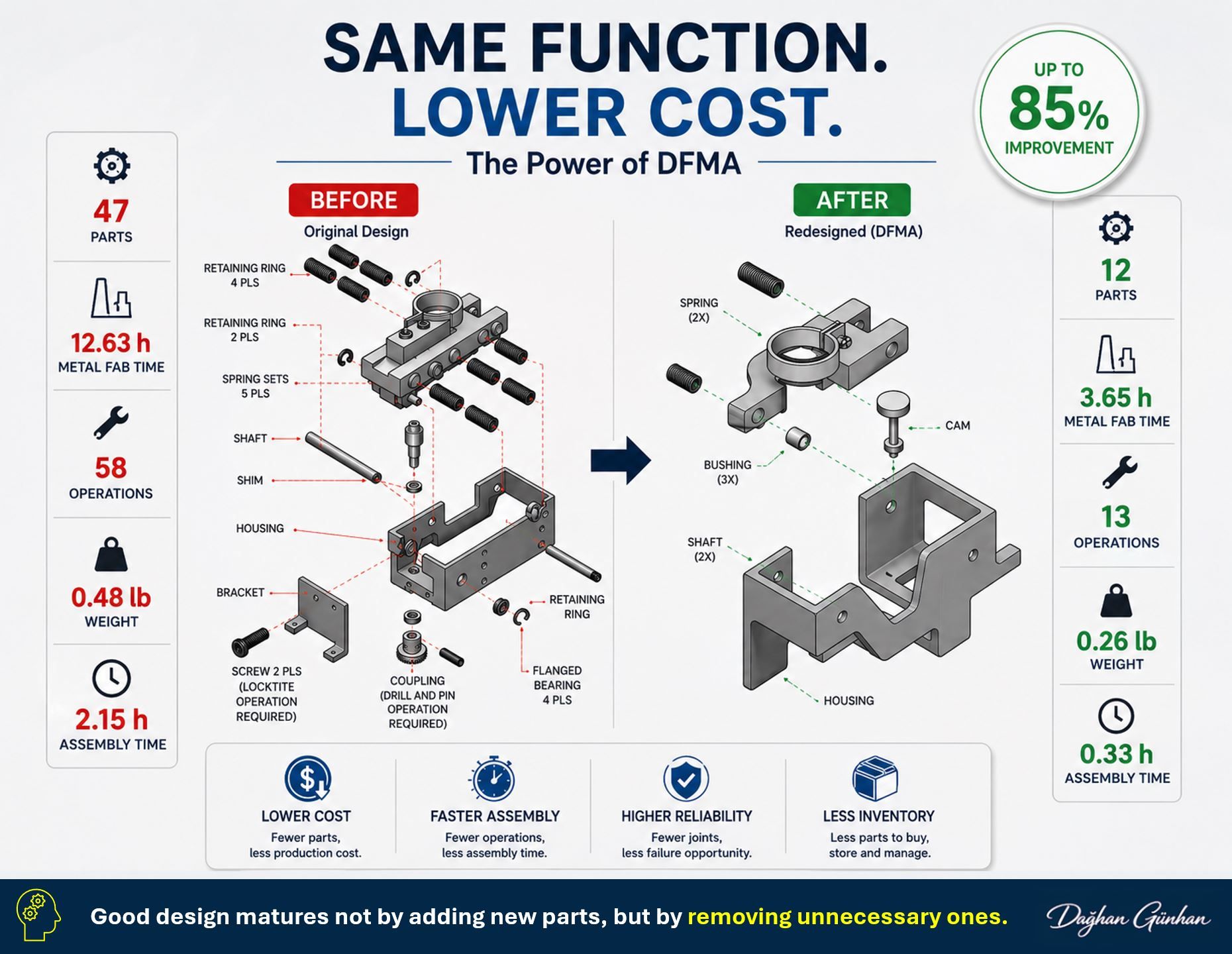
That is exactly the philosophy behind Design for Manufacture and Assembly (DFMA). The example below is a real case study from Geoffrey Boothroyd's Product Design for Manufacture and Assembly, one of the most influential books on the subject.
The product is a thermal sight reticle assembly developed by Texas Instruments' Defense Systems & Electronics Group (now Raytheon Systems) for an armored ground vehicle. This product wasn't just expected to be manufacturable — it also had to withstand ballistic shock, engine vibration, and dynamic loads caused by rough terrain, while maintaining precise optical alignment and keeping weight to a minimum.
Yet the design team asked a simple question: "can we make this product simpler?"
What the DFA analysis found
The biggest contributors to assembly time were not complex parts. They were:
- Fasteners
- Special assembly operations, such as applying Loctite adhesive to individual screws
- Repeated reorientation of the assembly during the assembly process
The redesign focused on eliminating exactly these issues.
The results
- The number of unique part designs was reduced from 24 to 8.
- The total number of parts was reduced from 47 to 12.
- Assembly operations dropped from 58 to 13.
- Assembly time was reduced by nearly 85%.
And most importantly: the product still performs exactly the same function.
The lesson
When you remove a part from a design, you don't just eliminate a single component. You also eliminate a drawing, a supplier, a stock item, a quality inspection step, an assembly operation, and one more potential source of failure.
The goal of good design is not simply to create a product that works. It's to create a product that delivers the same function with fewer parts and lower cost.
Engineering is not the art of adding parts. It's the art of removing the unnecessary ones.
Originally posted on LinkedIn.