April 19, 2026
A Large Portion of Your Results Comes From Boundary Conditions
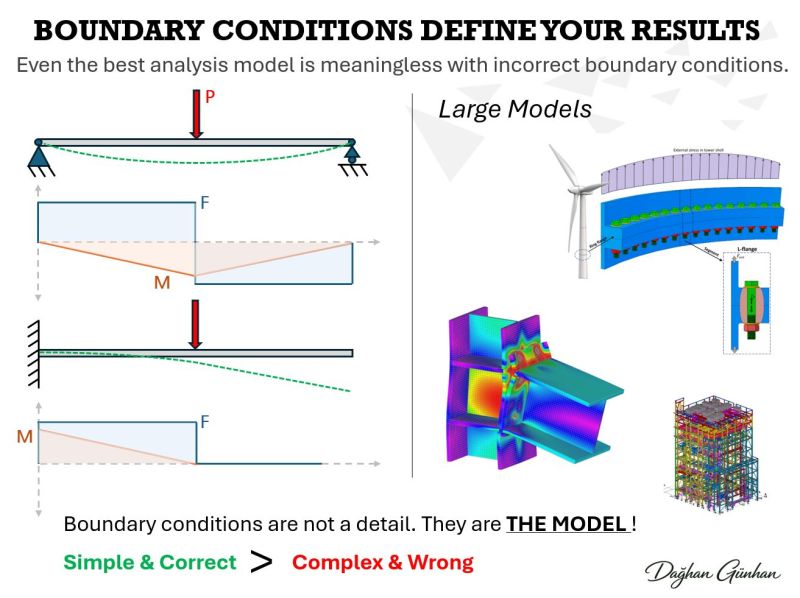
Beyond the Model Series #2
A large portion of your analysis results comes from boundary conditions. No matter how detailed your model is, incorrectly defined boundary conditions can lead you to completely wrong results. Because in analysis, the most critical question is: how is the system actually constrained in reality?
To give a very simple example, consider two shear force–bending moment diagrams that most engineers are familiar with. The system and the load are the same. Only the boundary conditions are different — and the result is completely different, even the critical region changes.
You might say "no one would make such an obvious mistake." But when you're working with complex systems consisting of hundreds of parts, can you still say that so easily?
What I often see in models
- Over-constrained models
- Rigid connections that do not exist in reality
- Ignoring assembly and mounting conditions
The result: the model may be stable, a solution is obtained — but the system it represents is not real.
For example, a system with bolted connections in reality may be modeled as fully fixed. In that case, stress distribution changes, natural frequencies shift, and system behavior becomes different. You may think you solved the correct model. But in reality, you solved the wrong system.
The takeaway
- Before defining boundary conditions, understand the real assembly and load path of the system.
- Fixtures, contacts, and connection details are the most critical parts of the model.
- A simple but correct model is always more valuable than a complex but wrong one.
In analysis, the most important thing is not mesh quality, not the material model, not the solver — it is correctly defined boundary conditions.
References
Originally posted on LinkedIn.